
A DHL Express package shipped from Paris to Munich typically takes two to three business days to arrive. When a strike occurs, whether on the French or German side, this timeframe can double or even triple, with little explanation provided by online tracking. The status “in transit” freezes, and we wait.
France-Germany and Germany-France Flow: An Asymmetry Not Shown by Tracking
There is a tendency to think that a strike slows packages down equally in both directions. However, feedback compiled from regular users shows the opposite.
When the strike affects French hubs, packages leaving France get stuck before they leave the territory. The last visible scan is on a French platform, sometimes for several days. The package has not yet been exported.
In the other direction, a package shipped from Germany to France experiences its blockage differently. It leaves German soil, reaches the last scanned hub, and then the status freezes on “in transit.” The incoming flow to France is limited or suspended, and the package waits for processing capacity to become available on the French side.
This helps explain why DHL delivery times between France and Germany during a strike vary so much depending on the shipping direction. This distinction does not appear anywhere on the DHL tracking page. The same label “in transit” covers two very different situations.
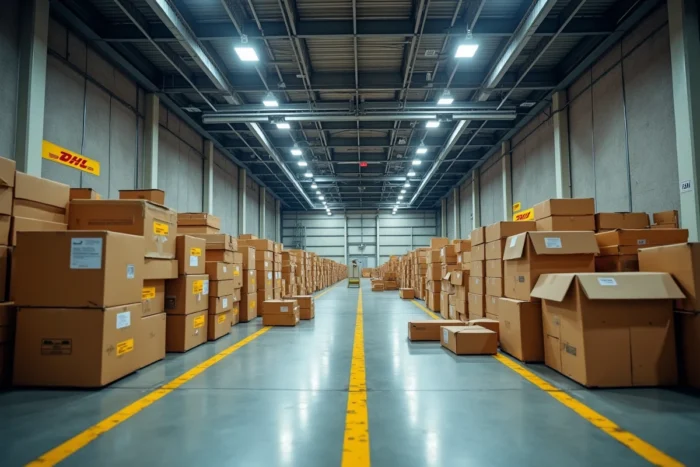
Leipzig Hub: The Critical Bottleneck for France-Germany Shipments
The Leipzig/Halle airport hub is a central node in the DHL Express network in Europe. When it operates normally, international packages transit through it in a few hours before being redistributed to their final destination.
During the strike in early June 2025 at DHL Hub Leipzig GmbH, around 1,000 employees stopped working at this site. The consequences were direct for shipments between France and Germany, as a large portion of European express freight passes through this platform.
What Happens When Leipzig Slows Down
Express packages are redirected to secondary hubs, adding one or more days to the journey. Standard (non-express) shipments are simply put on hold, with no rerouting.
On tracking forums, users have reported loops of “clearance event” in Leipzig, where the package seems to be scanned multiple times without progressing. This phenomenon indicates congestion at the sorting level, not a customs issue.
Returning to normal after this type of strike usually takes several additional days, as the backlog of waiting packages is resolved.
French Strikes, German Strikes: Different Impacts on Your DHL Deliveries
Strikes in France and Germany have different characteristics, and their effects on the DHL logistics chain vary.
- French strikes often affect air traffic controllers or ground transportation broadly, blocking all outgoing flows, not just DHL. Air and road freight are disrupted simultaneously.
- German strikes at DHL more often target a specific site (a hub, a sorting center), allowing the network to partially bypass the blockage by rerouting flows.
- Sectoral strikes in Canada have shown a more radical scenario: DHL Express had to completely suspend its operations in the country after a law prohibiting replacement workers came into effect. This type of total blockage remains rare on the France-Germany corridor.
In practice, a multi-day strike by French air traffic controllers (like those that cancel hundreds of flights) has a more diffuse but broader impact than a localized strike at a German hub.

Anticipate and React When the DHL Tracking Status Freezes
When the tracking shows “in transit” for more than 48 hours on an express France-Germany shipment, there are a few concrete actions to take.
Check the Source of the Blockage
The last visible geographic scan provides an indication. If the package is still scanned in France, the blockage is likely related to a strike or disruption on the French side. If it is scanned in Germany (Leipzig, Frankfurt), it is the German network or sorting hub that is saturated.
Actions That Make a Difference
- Contact DHL customer service, specifying the shipment number and asking if a rerouting is in progress. Customer service can sometimes force a redirection to an alternative hub.
- For business shipments, activating the delivery option to a pickup point or an alternative address can sometimes help unblock a package stuck on the “last mile.”
- Monitor DHL alerts published on their website (under “important information”), which report ongoing disruptions by country and service.
- For sensitive shipments, consider a two-step shipment: from France to a neighboring country not affected, then reshipping to Germany. This is costly, but some professional shippers use this method when timelines are critical.
Tracking information usually appears 24 to 48 hours after pickup. A longer silence during a strike does not mean the package is lost, but that it has not yet been scanned at a new platform.
The France-Germany corridor remains one of the busiest routes in the DHL network in Europe. Disruptions related to strikes resolve more quickly here than elsewhere, precisely because routing alternatives exist. Feedback varies on this point depending on the type of service chosen: an express shipment regains its fluidity much sooner than a standard shipment.