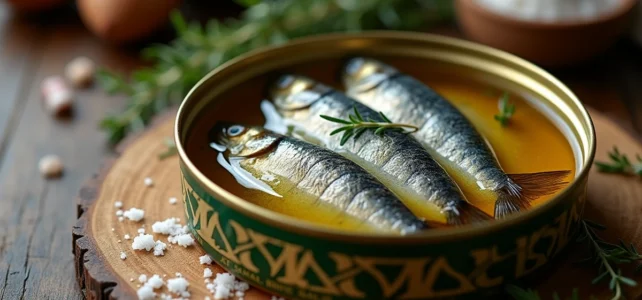
You grab a can of sardines at the supermarket, check the price, maybe the date. But do you turn the can over to read the ingredient list? Most consumers do not, and this is where the real differences between a quality can and a questionable one lie.
Heavy metals and sardines: a real but limited risk
The sardine is a small fish located at the bottom of the food chain. Compared to tuna, farmed salmon, or albacore, its exposure to mercury and heavy metals remains significantly lower. The reason is simple: the larger and longer-lived a fish is, the more contaminants it accumulates in its tissues. The sardine, with its short lifespan, largely escapes this phenomenon of bioaccumulation.
To better understand the dangers of canned sardines, it is important to distinguish the risk related to the fish itself and that related to its packaging. The container matters as much as the content.
The issue of food packaging is also subject to increasing regulation. The European Commission recently clarified the control methods for PFAS (per- and polyfluoroalkyl substances) in food packaging, which directly concerns the inner coatings of certain cans. Serious brands use BPA-free inner varnishes, but not all communicate clearly on this point.

Canned sardines: what the label reveals about quality
The ingredient list of a can of sardines should be short. Sardines, olive oil (or water, or sunflower oil), salt. Three to four ingredients are sufficient. When you read a list of six, eight, or ten components with flavors, flavor enhancers, or mixed oils, the can strays from the raw product.
The oil used changes everything
Have you noticed that some cans state “vegetable oil” without specifying which one? This ambiguity often hides the use of low-quality soybean or rapeseed oil. Prefer cans that explicitly name extra virgin olive oil. Sardines in their natural state (in water) remain the most neutral option, ideal if you want to limit added fat intake.
Origin and fishing method
The origin of the fish must be indicated on the label. A sardine caught off the French coasts (Atlantic, Mediterranean) or off the coast of Portugal does not have the same profile as a sardine from distant and less regulated fishing areas. The MSC (Marine Stewardship Council) label certifies sustainable fishing, but it does not guarantee anything about taste quality or the absence of contaminants.
- Check the FAO fishing area indicated on the can: areas 27 (North-East Atlantic) and 37 (Mediterranean) correspond to European sardines.
- Look for the mention “purse seine fishing” or “coastal fishing,” techniques that preserve the quality of the fish and limit bycatch.
- The Label Rouge, the only official French label of taste excellence for sardines, imposes strict criteria for freshness and preparation.
Health regulations for canned fish: what changes in 2026
The microbiological safety of canned goods will be strengthened. Starting July 1, 2026, the European regulation modifies the criteria applicable to Listeria monocytogenes in ready-to-eat foods. Specifically, manufacturers will have to prove the complete absence of Listeria in 25 g of product throughout the shelf life of the can, unless they scientifically demonstrate that the bacteria will not exceed the regulatory threshold.
This tightening forces brands to enhance their durability studies and sampling plans. For consumers, this is a positive signal: canneries that invest in these controls produce safer products. Brands that communicate about their certifications (IFS, BRC) or publish their analysis results offer appreciable transparency.
The RappelConso website (rappel.conso.gouv.fr) lists products recalled from the market. Checking it regularly helps identify brands that have recently been recalled in the canned fish category.
Canned sardines and health: frequency and consumption precautions
The sardine remains one of the most nutritionally interesting fish. Rich in omega-3, calcium (thanks to the bones consumed with the flesh), vitamin D, and vitamin B12, it ticks most boxes of a health food. Two to three servings of fatty fish per week are recommended by health authorities, and sardines naturally fit into this.
The main risk associated with excessive consumption of canned goods does not come from the fish. It comes from salt. A can of sardines in oil contains a significant amount of sodium. To limit this exposure, here are two practical options:
- Choose sardines in their natural state or “no added salt” versions, which are available from several brands.
- Rinse the sardines briefly in water before consuming, which reduces the surface salt content.
- Alternate canned sardines with fresh seasonal sardines (available from April to October on the French coasts).

Botulism, although extremely rare in industrial canned goods, remains a theoretical risk associated with poorly sterilized artisanal cans. A bulging, dented can, or one whose lid does not withstand pressure should be discarded without hesitation. Industrial canneries apply sterilization (canning) protocols that eliminate this risk in the vast majority of cases.
Ultimately, choosing a good can of sardines relies on three criteria that can be verified in seconds: a short ingredient list with a named oil, an identified European fishing area, and a can in perfect physical condition. These three points effectively filter out the majority of low-quality products, without needing to become an expert in food science.