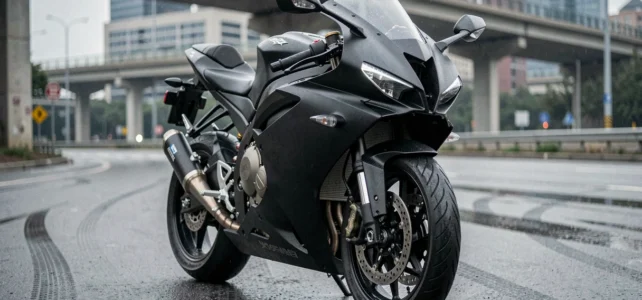
Since Yamaha confirmed the absence of an Euro 5+ version for the YZF-R1, the Japanese supersport is no longer road-legal in Europe. The remaining available units are marked Race or GYTR, reserved for the track. For riders who used to ride the R1 daily, the question is no longer about finding a bike with equivalent displacement or raw power, but rather identifying which sportbikes remain road-legal while offering a comparable level of performance.
Road-legal 1000 cc sportbikes: the table of direct rivals
Four manufacturers maintain a high-displacement supersport in the European catalog with road approval. The table below summarizes the key characteristics to position each model against the former R1.
| Model | Engine | Claimed Power | Dry Weight (approx.) | Onboard Electronics |
|---|---|---|---|---|
| Kawasaki ZX-10R | Inline 4-cylinder, 998 cc | About 200 hp | Less than 210 kg | 6-axis IMU, riding modes, traction control |
| Honda CBR1000RR-R Fireblade | Inline 4-cylinder, 999 cc | Over 215 hp | Around 200 kg | Wheelie control, quickshifter, IMU |
| Suzuki GSX-R1000R | Inline 4-cylinder, 999 cc | About 200 hp | Around 200 kg | 10-level traction control, quickshifter |
| BMW S 1000 RR | Inline 4-cylinder, 999 cc | Over 205 hp | Less than 200 kg | DTC, ABS Pro, M modes |
The common point: all feature an inertial measurement unit and advanced electronic aids. The power gap between these four machines remains small, on the order of a few horsepower. It is in the chassis, ergonomics, and price that the differences widen.
For those looking to replace the Yamaha R1 with a sportbike that is equally versatile, the Fireblade and the S 1000 RR stand out for their level of standard equipment, while Suzuki’s GSX-R1000R is often positioned at a more accessible price point.
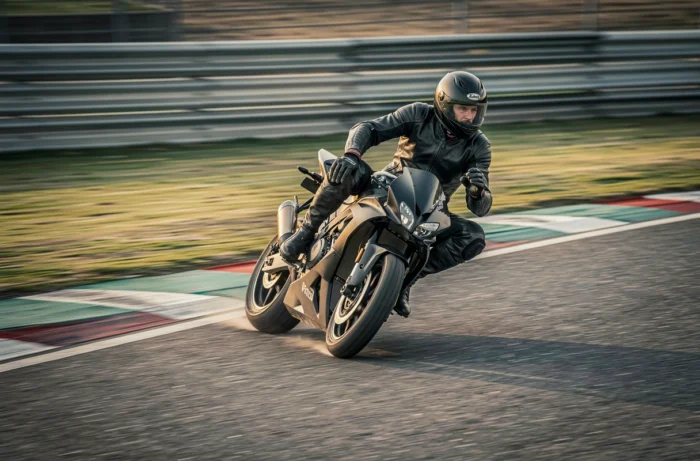
Honda CBR1000RR-R vs BMW S 1000 RR: two sporting philosophies
These two models attract the attention of former R1 owners, and for a simple reason: their electronics are the closest to what Yamaha offered. Honda’s Fireblade pushes the logic of pure performance with an engine derived from the MotoGP RC213V. The maximum power RPM is very high, giving it an explosive character in the revs.
The BMW S 1000 RR takes a different approach. Its ShiftCam engine, with variable intake valve timing, delivers torque lower in the rev range. The result: a bike that is more usable on open roads, less demanding in slow corners.
Ergonomics and daily use
The riding position of the CBR is among the most radical in the segment. The footpegs are high, and the torso is very leaned forward. On a ride longer than an hour, fatigue sets in.
The S 1000 RR offers a slightly more upright position. BMW has also integrated an optional cruise control, indicating a desire to make the bike usable beyond the track. The BMW remains the most versatile 1000 sportbike on the market for mixed road and track use.
Kawasaki ZX-10R and Suzuki GSX-R1000R: the price-performance ratio
The Kawasaki ZX-10R benefits from decades of development in Superbike. Its chassis is predictable, and its engine is linear. It does not surprise, and that is precisely its strength: the handling is quick for a rider accustomed to the R1.
Suzuki’s GSX-R1000R occupies a unique position. Suzuki has not renewed this platform for several years, raising questions about its longevity in the catalog. However, this also means that the model is mature, reliable, and that the parts network is well established.
- The ZX-10R suits riders who want to find handling close to the R1 without a long adaptation period, thanks to similar chassis geometry.
- The GSX-R1000R appeals with its often lower selling price compared to direct competitors and its reputedly less expensive maintenance.
- Both models share a common limitation: their electronics, while competent, lag behind Honda and BMW’s latest generation systems.
The Yamaha YZF-R9: staying in the R family without the R1
Yamaha is preparing the arrival of the YZF-R9, positioned to fill the gap left by the discontinuation of the R6 and the absence of a road-legal R1. This model is based on a new platform, with an intermediate displacement engine. The stated goal: to offer a modern sportbike, compliant with anti-pollution standards, while retaining the DNA of the R range.
For an R1 owner attached to Yamaha, the R9 represents the logical transition. The power will be lower than that of a 1000, but the contained weight and next-generation electronics could compensate on open roads.
A sporting segment in full reorganization
The cessation of the road R1 and R6 (whose production is definitively ending, with the last deliveries planned for the Japanese market) illustrates a broader movement. Manufacturers are gradually reducing their offering of pure thermal supersports in favor of sport-touring models or mid-displacement bikes that are more compatible with Euro 5+ standards.
- BMW is actively developing a new version of the S 1000 RR to maintain its competitiveness in Superbike and on the road.
- Kawasaki retains the ZX-10R but is also investing in hybrid and electric in other segments.
- Honda is betting on the Fireblade as a technological showcase, with a direct link between its racing bike and the production model.
The market for road-legal 1000 sportbikes is shrinking every year. For a former R1 rider, the choice depends less on the raw technical sheet than on actual use: road, track, or both. The Fireblade excels in pure performance, the S 1000 RR in versatility, and the R9 could redefine what Yamaha offers to sport riders. Waiting a few months to see the R9 in real conditions is not the worst strategy.