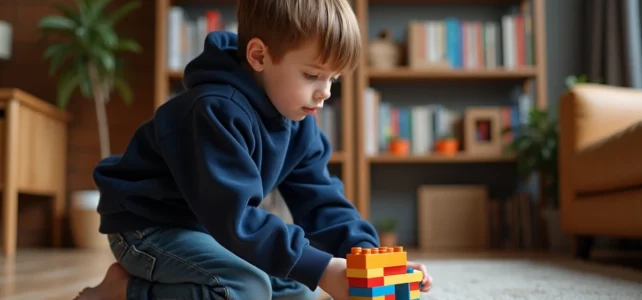
At eight years old, a child enters a phase where their tastes become more defined, their friendships shape their choices, and their cognitive abilities allow them to carry out projects over several days. Identifying what truly engages them requires going beyond a simple list of proposed activities to analyze the nature of their commitment: duration of concentration, type of task sought, preferred social context. It is this framework that allows for support without projection.
Creative, sports, or digital activities: where does engagement truly lie at 8 years old
Competitors often group interests into broad categories (sports, art, nature) without distinguishing what the child actually does in each category. The difference between a child who draws to calm down and a child who draws to tell a story is, however, crucial for parental support.
| Type of activity | Dominant mode of engagement | Signal to observe |
|---|---|---|
| Hands-on activities (drawing, construction, DIY) | Solitary concentration, search for tangible results | The child spontaneously starts again after a failure |
| Team sports (football, basketball, handball) | Social interaction, need for clear rules | They talk more about the team than their own performance |
| Individual sports (swimming, gymnastics, climbing) | Personal achievement, technical mastery | They set micro-goals without being asked |
| Creative digital (robot programming, video editing, game creation) | Project logic, problem-solving | They seek to show the final result, not just to play |
| Board games, puzzles, scientific challenges | Strategic reasoning, cooperation | They modify the rules to complicate the game |
This table is not intended to classify a child into a box. It serves to identify the mode of engagement rather than the discipline itself. A child drawn to project logic will benefit equally from a woodworking workshop as from a robotics kit.
To delve deeper into the interests of 8-year-olds according to their profile, it may be useful to cross these observations with the school and family context.
Creative digital activities for the 8-year-old: beyond screen time
The issue of screens monopolizes parental debate, often reduced to a counting of hours. This approach masks a fundamental distinction between passive consumption (videos, repetitive games) and creative project-oriented use.
In recent years, the digital practices of third-cycle children have evolved towards creation: programming small educational robots, audio editing, designing mini-games. These activities require perseverance, problem decomposition, and planning, skills that watching content does not engage.
What distinguishes creative use from passive use
- The child produces a result they can show or share (a program, a video, a game path), whereas passive use leaves no trace
- They encounter obstacles they must solve themselves, generating temporary frustration but also lasting satisfaction
- The time spent is organized into work sessions with a goal, not into open-ended sessions without a defined end
Guiding does not mean prohibiting, but directing towards production. Offering a visual programming software suitable for 7-10 year-olds transforms the relationship with screens without conflict.
Interdisciplinary projects at school: how the third cycle reshapes children’s tastes
Recent adjustments to the national education programs for the third cycle strengthen transversal skills: cooperation, project management, creativity. In practice, this translates into more scientific challenges in class, group work, and projects combining multiple subjects.
This evolution has a direct effect on the interests expressed at home. A child exposed to a technological challenge in class may develop a taste for construction or experimentation that they would not have verbalized otherwise. School acts as a revealer of latent tastes, not just as a place for formal learning.
Exploiting the school-home link to refine observation
Consulting the project notebook or school productions provides concrete clues. A child who invests more energy in the “research” part of a presentation than in the oral presentation has a different profile from one who shines orally but rushes the preparation.
On the other hand, replicating the school format at home is counterproductive. The interest identified at school benefits from being extended in a more relaxed setting: a club, a workshop, or simply materials provided without instructions.
Duration of concentration and activity abandonment: interpreting signals at 8 years old
An eight-year-old child who abandons an activity after a few weeks does not necessarily send a signal of instability. At this age, the capacity for projection remains limited. The child tests, compares, adjusts. The problem arises when abandonment is systematic and nothing takes its place.
Two parameters deserve attention. The first is spontaneous concentration duration: if a child remains absorbed for more than half an hour without external prompting on a chosen task, it is a reliable marker of genuine interest. The second is the ability to resume an activity after an interruption, for example, returning to a drawing started the day before or restarting a construction project.
A child who never shows this type of perseverance on any activity may simply lack exposure to suitable formats. Varying the proposals (outdoor/indoor, alone/in a group, hands-on/intellectual) before concluding a general disinterest remains the most reliable approach.
Parental support does not consist of finding “the” passion of the child, but rather multiplying opportunities for real engagement and observing what endures over time. At eight years old, a solid interest is recognized less by initial enthusiasm than by the regularity with which the child returns to it without being prompted.