
In biblical texts, the fly never appears by chance. It is associated with corruption, decomposition, and the fragility of what is believed to be stable. Several books of the Old Testament use this insect to signify disorder, whether moral, cosmological, or political.
Baal-Zebub and the Apotropaic Cults of the Ancient Near East
The starting point for understanding the significance of the fly in the Bible lies in a proper name: Baal-Zebub, literally “lord of the flies.” This title refers to a deity mentioned in the second book of Kings, consulted by King Ahaziah of Israel.
The classical interpretation reduces Baal-Zebub to a synonym for Satan, a figure of absolute evil. Recent exegetical research nuances this reading. In the ancient Near East, this type of deity could be linked to protection against insect-borne diseases, a so-called apotropaic cult (intended to ward off a plague).
This distinction changes the perspective: the fly is not merely a demonic emblem. It also represents what one sought divine protection against. The biblical text critiques the recourse to this foreign deity, not so much the insect itself but the act of attributing power to it that belongs to the God of Israel.

Flies of Exodus: the Fourth Plague between Punishment and Disorder of Creation
The book of Exodus (chapter 8) describes the sending of swarms of venomous flies upon Egypt, the fourth plague inflicted upon Pharaoh. The text specifies that the land of Goshen, where the Hebrew people reside, is spared.
The most widespread reading emphasizes the punitive dimension: God punishes Egypt to obtain the liberation of His people. Contemporary exegetes propose a complementary framework, articulated around the theology of creation.
In this cosmological reading, the plagues represent a return to the chaos preceding Genesis. The flies, like the frogs or locusts, embody uncontrolled proliferation, an ecosystem that escapes the order intended by the Creator. The plague does not only target Pharaoh: it signals that the refusal to free Israel causes a disruption of the entire creation.
The Goshen/Egypt Distinction as a Theological Marker
The text emphasizes the geographical separation between the affected land and the spared land. This narrative technique serves a specific purpose: to demonstrate that divine action is targeted, ordered, in exact opposition to the disorder that the flies embody.
The fly then becomes a tool of contrast. Its uncontrollable swarm makes visible, by opposition, the mastery of the biblical God over His creation.
Ecclesiastes 10: the Dead Fly in the Perfumer’s Oil
The verse from Ecclesiastes 10:1 condenses the symbolism of the fly into a striking image: “Dead flies infect and ferment the oil of the perfumer; a little folly outweighs wisdom and honor.”
This wisdom proverb operates on a principle of disproportion. A tiny element (the dead fly) is enough to corrupt a product of great value (the perfumed oil). The moral application is direct: a small fault can ruin an entire reputation.
Three dimensions overlap in this verse:
- The fragility of what is precious, as wisdom and honor do not withstand the slightest contamination.
- The irreversible nature of corruption: the altered perfume cannot be restored, just like lost trust.
- The warning against neglecting “small things,” a recurring theme in Hebrew wisdom literature.
This passage has had the most impact on the Christian tradition in its pastoral use. It serves as the basis for numerous teachings on daily moral vigilance.
Biblical Fly and Ecology: a Tensioned Symbol
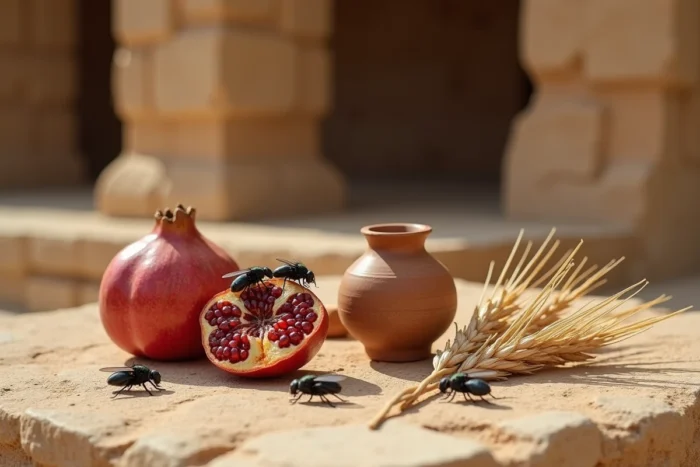
Recent Christian literature increasingly places the biblical symbol of the fly in tension with its actual ecological role. The fly decomposes organic matter, participates in nutrient recycling, and pollinates certain plants. It is, biologically, an agent of renewal.
This tension produces an interesting reinterpretation. The biblical fly embodies corruption and decomposition, but decomposition is also a necessary process for life. The symbol of pollution coexists with a function of transformation.
Some axes of this contemporary reinterpretation:
- The fly as a reminder that death nourishes life, a cycle that the Bible itself recognizes in other passages (the grain that dies in John 12).
- The link between decomposition and humility: what culture rejects (the insect, the waste) has a place in the created order.
- The difficulty of reconciling a negative spiritual symbol with a positive ecological fact, a tension that enriches the text instead of simplifying it.
This approach does not contradict traditional symbolism. It complements it by reminding us that biblical texts often operate through tension between two poles, not by assigning a single meaning.
Sacred Art and the Representation of the Fly in Christian Tradition
In Flemish and Italian Renaissance painting, the fly appears in still lifes or religious portraits. Its presence is never decorative. It signals vanity, the brevity of life, the perishable nature of all human work.
Some paintings place a fly directly on the face of a saint or on a ripe fruit. The message aligns with that of Ecclesiastes: even what seems complete, beautiful, or sacred remains exposed to corruption. The fly in sacred art extends the biblical text by making it visual, tangible.
This artistic treatment confirms that the fly has not lost its symbolic weight by leaving the text. It has migrated to other mediums, retaining its function as a memento mori, a reminder of mortality addressed to both the viewer and the believer.
Thus, the biblical fly is neither a simple plague nor a univocal metaphor for evil. It functions as a sign with multiple entries: cosmic disorder, moral fragility, tension between corruption and renewal. Its presence in the text compels one to confront what one would prefer to ignore, making it, paradoxically, difficult to erase from memory.