Cold toes in the morning, tingling after an hour of sitting, a feeling of heaviness at the end of the day: these signals almost always originate from the same place, the foot. Far from the heart and subjected to gravity, the foot concentrates circulatory difficulties long before the rest of the leg shows any signs. A few targeted actions can help restart the blood flow locally, without expensive equipment and without taking risks.
Foot pump and toe mobility: two often-overlooked mechanisms
Have you ever noticed that walking barefoot on sand quickly relieves heavy feet? It’s not just about the coolness. The rolling motion of the foot on the ground activates what is called the foot pump, a venous network located under the arch that propels blood upward with each step.
When the foot remains stationary in a rigid shoe for hours, this pump hardly works. Blood stagnates, veins dilate, and sensations of tingling appear. Voluntarily moving the toes, spreading them apart and then curling them several times in succession, restarts this mechanism without any particular effort.
In practice, three to four sets of toe flexions and extensions, spaced throughout the day, are enough to maintain a minimal flow. This action can be done under a desk, on a train, or in front of the television. Several approaches can improve circulation in the foot by combining this active mobilization with other targeted habits.
Heat and prolonged standing: the two seasonal enemies of the foot
Content on circulation often mentions sedentariness. They overlook a major aggravating factor: heat dilates veins and slows down blood return. In summer or in an overheated environment, the foot swells more quickly and symptoms intensify.
Standing for long periods on a hard surface further amplifies the problem. Gravity pulls blood downward, the foot pump only activates weakly, and heat prevents veins from contracting properly.
Concrete actions to counteract heat
- Rinse your feet and ankles with cool water for one to two minutes, moving from the foot up to the knee, to induce natural vasoconstriction
- Elevate your feet a few centimeters (a cushion, a stack of books) as soon as you sit down, to reverse hydrostatic pressure
- Avoid closed and synthetic shoes in hot weather, as they trap heat around the foot and promote swelling
- Drink regularly, as dehydration thickens the blood and complicates its passage through the small vessels of the foot
These adjustments may seem simple. However, their combined effect on a hot day is measurable: the foot deflates, tingling decreases, and the feeling of heaviness significantly recedes.
Compression socks: an underestimated tool when well chosen
Compression is often associated with post-operative medical use. In reality, light compression socks are suitable for daily use for anyone prone to heavy or swollen feet.
The principle is mechanical: the fabric exerts a decreasing pressure, stronger at the ankle and decreasing towards the calf. This pressure helps veins push blood upward, partially compensating for the deficiency of the foot pump in less mobile individuals.
What makes a difference in use
Many people abandon compression socks after a few days because they have chosen a poorly fitting model. Too tight at the toes, too loose at the ankle, or simply difficult to put on.
Recent models offer easier openings for seniors and softer materials that slip on effortlessly. Choosing the right size involves measuring the circumference of the ankle in the morning, when the foot is not yet swollen. Taking this measurement at the end of the day leads to choosing a size that is too large, which negates the compressive effect.
When cold or numb feet require medical advice
Not all circulatory issues in the foot can be resolved with simple wellness tips. Some signals indicate a vascular problem that requires diagnosis.
- A persistent color change (bluish, purplish, or very pale foot) that does not disappear with movement or leg elevation
- A lasting loss of sensitivity in the toes, different from transient tingling related to a static position
- Pain at rest, especially at night, that prevents sleep and does not subside with usual actions
- Wounds on the feet that heal very slowly, especially in people living with diabetes
These situations do not resolve with a foot bath or toe flexions. They may signal arteritis, a neuropathy issue, or advanced venous insufficiency. Consulting a doctor as soon as these signs appear prevents serious complications.
Foot massage and circulation: what really works
Massaging the foot after a long day provides immediate relief. The massage acts in two ways: it mechanically stimulates blood flow in the superficial tissues, and it releases muscle tension that may compress small vessels.
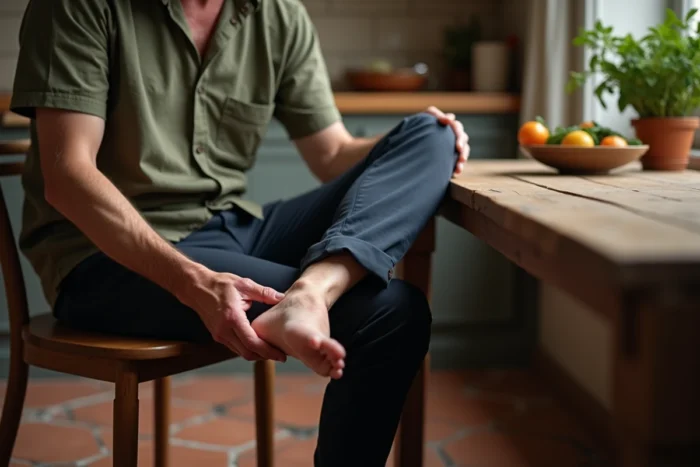
The most accessible technique involves rolling a ball (tennis, foam ball) under the arch for a few minutes. This movement passively activates the foot’s venous pump without muscle effort.
For the hands, a circular massage from the heel to the toes, with moderate pressure, replicates the natural direction of venous return. Pressing too hard does not provide additional benefits and risks irritating the tissues, especially in individuals with sensitive skin.
Vibrating foot massage devices are gaining popularity. They can complement manual actions, provided they are not used on damaged skin or in cases of known phlebitis.
Maintaining circulation in your feet relies on regular actions rather than a one-time solution. Mobilizing the toes, adapting your shoes to the season, using compression when relevant, and monitoring warning signals: these four reflexes cover the vast majority of everyday situations. The foot, being the lowest point of the body, simply requires a bit more attention than the rest.