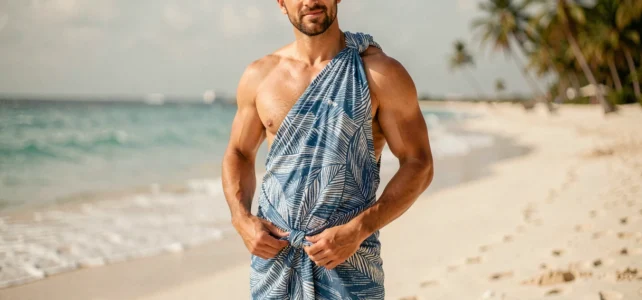
The men’s pareo is gradually leaving the Polynesian shores to settle into urban locker rooms. The spring-summer 2026 collections from houses like Dries Van Noten and Balmain incorporate the sarong as a hip wrap or layered skirt worn over pants. This shift from beachwear to a full-fledged fashion piece changes the approach to tying: technique is just as important as the choice of fabric or the desired silhouette.
Choosing the Right Fabric Before Tying a Men’s Pareo
The success of a tie depends as much on the material as on the gesture. A fabric that is too stiff won’t stay in place, while a fabric that is too thin will slip with the first movement. Lightweight cotton and viscose remain the most reliable fibers for a men’s pareo: they accept the knot without excessive wrinkling and maintain a decent hold for several hours.
The size of the rectangle of fabric also influences tying options. A standard pareo measures about twice the width of the hips, which provides enough material to cross the ends and form a solid knot. Narrower formats limit the possibilities to a short skirt or a simple waist wrap.
To learn how to wear and tie a men’s pareo according to the fabric cut you have, the starting point remains the actual width of the pareo in relation to your waist measurement.
In terms of patterns, the 2026 trend leans towards natural tones and masculinized prints (wide stripes, tone-on-tone tie-dye, color blocks) rather than classic tropical hibiscus. This aesthetic shift makes it easier to wear the pareo outside of the beach, including on a restaurant terrace or in the city.
Waist Knotting: The Basic Technique for Men’s Pareo
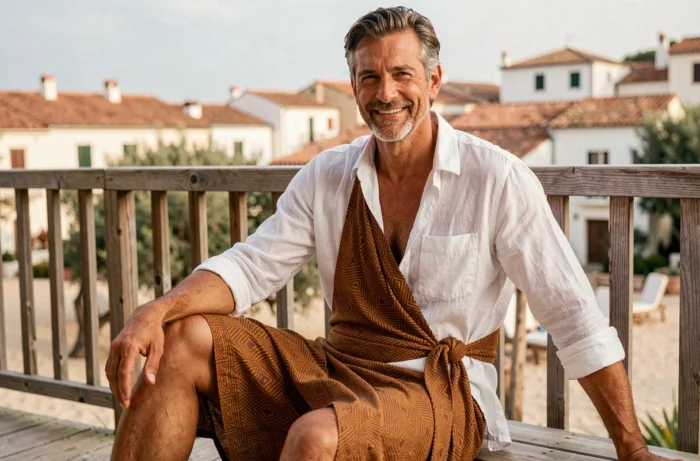
The waist knotting is the fundamental gesture. It produces a mid-length skirt, the most common look in French Polynesia, used daily by participants in Tu’aro Ma’ohi (traditional Tahitian sports).
Steps for Classic Knotting
- Hold the pareo behind you, arms outstretched, the top edge aligned with your waist (not on the hips, which would cause the fabric to slip).
- Bring both ends forward, crossing the ends over your belly, with the right end going over the left end (or vice versa, depending on your comfort).
- Roll the two ends together on themselves, then fold the roll down under the fabric belt to secure everything. A double flat knot also works, but the rolled method holds better during large movements.
- Adjust the length: the bottom of the pareo should reach between the knee and mid-calf for a proportional look. Shorter styles lean towards beach shorts; longer ones approach a long skirt, which requires a fluid fabric to avoid weighing down the silhouette.
The rolled knot has a practical advantage rarely mentioned in tutorials: it distributes tension across the entire width of the waist instead of concentrating the tightness on a single point. The pareo stays in place even when walking quickly or bending down.
Men’s Pareo Worn as Shorts: A Knotting Technique that Changes the Silhouette
The shorts knotting is suitable for situations where the skirt seems too dressed up or too exposed to the wind. The method starts from the same basic gesture, with an additional step.
After crossing the ends at the front, pass the excess fabric between your legs to the back, then tuck it into the fabric belt at the level of your lower back. The result resembles loose bermuda shorts, comfortable for swimming or walking on sand.
This technique works only with a sufficiently wide pareo. A rectangle that is too narrow won’t provide enough fabric for passing between the legs and securing at the back. If the fabric is lacking, stick to the classic skirt knotting.
Wearing a Men’s Pareo in an Urban Context: What Works
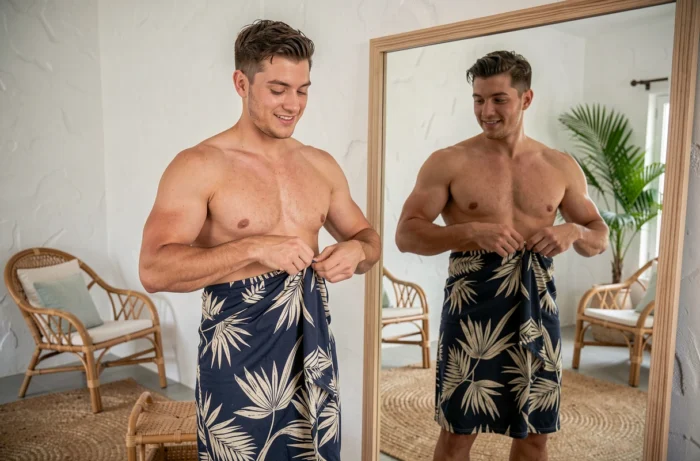
The spring-summer 2026 runway shows feature the sarong layered over pants or jeans, tied at the hip like a hip wrap. This style doesn’t require complex knotting: a simple hip wrap with the ends tied at the side is enough. The effect relies more on the choice of fabric and colors than on the technique.
Layering changes the game. Instead of replacing the bottom, the pareo adds as a decorative layer, like an asymmetrical apron. The recently emerged “utility” versions, featuring patch pockets and integrated belts, facilitate this approach by eliminating the need to tie anything.
Three Mistakes that Reveal Poorly Mastered Knotting
- Tying too high, under the ribs: the fabric gapes and the pareo rides up while walking. The natural waist (at the navel) remains the most stable anchor point.
- Using a simple knot instead of a flat or rolled knot: the fabric comes undone after a few minutes, especially with a slippery material like viscose.
- Choosing a pareo that is too short for one’s body type: tall men need an XL size (at least 180 cm wide) to achieve a proper fall and sufficient crossing of the ends.
The men’s pareo remains a technical garment in the sense that the knotting determines comfort and hold over time. The material, size, and gesture form a cohesive whole. A well-suited fabric poorly knotted holds less well than an average fabric perfectly rolled at the waist. Testing two or three different knots with the same pareo is usually enough to find the one that suits your body type and intended use.