A cold saponified soap poorly retains the volatile molecules of essential oils: a large part degrades or evaporates during the curing process. Scenting a homemade soap without using them is therefore not a constraint, but a coherent approach with the process itself. Several plant-based raw materials release stable odoriferous compounds in a soap paste, provided one understands how they react to the contact of lye and heat.
Fragrance allergens in handmade soap: what the regulation 2023/1545 changes
Regulation (EU) 2023/1545 has expanded the list of fragrance allergens to be declared on cosmetics, increasing from about 26 to over 80 substances. Among the new allergens are vanillin, menthol, camphor, and carvone, molecules naturally present in many botanical ingredients.
From July 31, 2026, any handmade soap placed on the EU market (including sold online or at a local market) must individually list these allergens as soon as they exceed 0.01% in a rinsed product. A soap scented with vanilla or citrus zest is not exempt from this obligation, even without essential oil in the formula.
Knowing how to scent a homemade soap now involves checking the allergenic composition of each chosen fragrant ingredient. Plant powders and macerates are not exempt: coumarin from tonka beans, eugenol from cloves, or cinnamal from cinnamon are on the expanded list. Formulating a naturally scented soap also means anticipating labeling.
Plant powders and spices: materials that endure the cure
Not all plant powders behave the same way in cold soap. Their ability to diffuse a fragrance depends on the nature of the odoriferous molecules they contain and the resistance of these molecules to the alkaline pH of the paste.
Fragrance powders stable after saponification
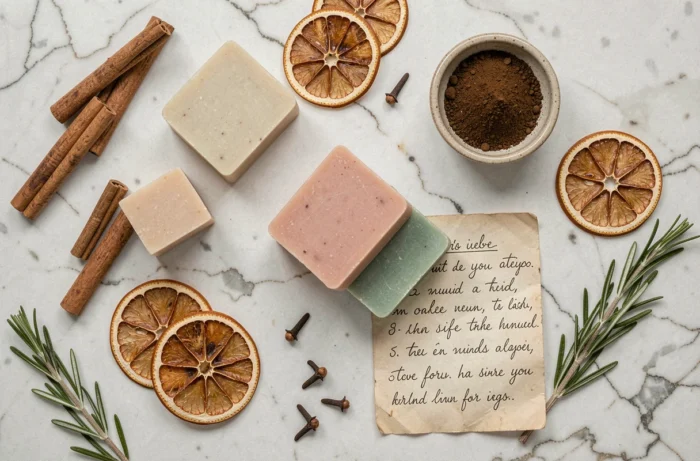
Unsweetened cocoa powder releases pyrazines and aldehydes that withstand lye well. The olfactory result persists for several months after curing. Cinnamon powder (Cinnamomum verum) also retains its scent, but the cinnamic aldehyde it contains can cause skin irritation in some people, in addition to being a regulated allergen.
Turmeric provides an intense golden color and a subtle earthy note. Green clay or activated charcoal, often associated with “detox” soaps, do not scent but serve as a support: they adsorb the odoriferous molecules from other ingredients and prolong the scent retention in the finished product.
Dosage and timing of incorporation
The powders are added at trace, never in the lye solution. An addition too early exposes the volatile compounds to increased thermal and chemical degradation. For dosages, here are some guidelines:
- Cocoa is dosed between one and three tablespoons per kilogram of oils. Beyond that, the soap may become grainy and the foam may brown significantly.
- Ground spices (cinnamon, ginger, clove) are used in smaller quantities, as they can accelerate trace and make working with the paste difficult.
- Root powders (iris, marshmallow) act more as fragrance fixatives rather than as sources of scent. They combine with a macerate or another fragrant ingredient to stabilize the diffusion.
Oil macerates and infusions: extracting fragrance before saponification
An oil macerate involves infusing a plant material in a base oil for several weeks. The oil captures the liposoluble molecules of the plant, including some of its odoriferous compounds. The macerate then replaces a fraction of the base oil in the soap recipe.
Vanilla (split pods in olive oil), dried lavender, or citrus zest yield macerates whose fragrance partially transfers to the soap. Vanilla darkens the paste due to the vanillin oxidizing in contact with lye, a cosmetic effect to anticipate in the choice of mold and presentation.
Aqueous infusions as dissolution liquid
Replacing the lye dissolution water with a concentrated infusion (strong coffee, green tea, rosemary herbal tea) adds a subtle olfactory note. Coffee is the most reliable: its roasted aromatic compounds withstand alkalinity better than floral infusions, which lose almost all of their fragrance.
The infusion must be cooled, even chilled, before dissolving the lye in it. The exothermic reaction between lye and liquid can easily rise above 80 °C. A liquid that is already hot risks causing splashes and destroying the remaining aromas.
Scented soap without essential oils: combining techniques for a lasting result
A single fragrant ingredient rarely produces a satisfying scent in cold soap. Saponification degrades some of the molecules, and the several-week cure allows the most volatile ones to evaporate. Combining multiple fragrance sources, across complementary registers, yields a more persistent result.
- Combining an oil macerate (base note, liposoluble) with a spice powder (heart note, insoluble) and an infusion (light note, hydrosoluble) covers three different diffusion modes.
- Adding a fixative powder (iris root, arrowroot) to the paste at trace helps retain volatile compounds during curing.
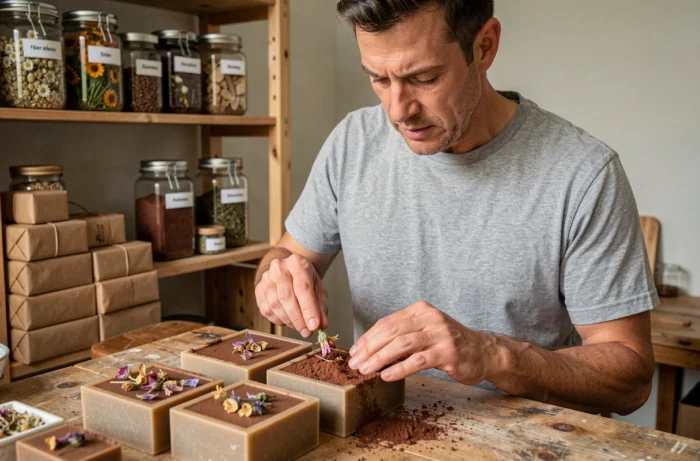
- Incorporating textural elements (oat flakes, poppy seeds) does not directly scent, but these inclusions release a vegetal note at the time of use, when the wet soap is rubbed.
The color of the finished soap often reflects the chosen fragrant ingredients. A soap with cocoa and coffee will be dark brown. A soap with turmeric and chamomile infusion will lean towards yellow. Embracing this natural palette is part of the process: a scented soap without essential oils does not resemble an industrial soap, neither in its scent nor in its appearance.
The reformulation of allergens imposed by regulation 2023/1545 makes the choice of simple and traceable ingredients even more relevant. A soap formulated with three or four identified raw materials is easier to label than a soap containing a synthetic fragrance blend with dozens of components. The simplicity of the formula, in this regulatory context, becomes a practical as well as aesthetic advantage.