
The creative DIY market in France is worth several tens of billions of euros, and the practice of DIY goes far beyond mere leisure. Since the anti-waste law for a circular economy (AGEC), the materials purchased or salvaged for handmade creations are now part of organized collection and recycling streams. Making things at home is now framed within a regulatory context that encourages the reuse of objects, textiles, and decorative construction materials.
AGEC Law and REP Systems: What Home DIY Owes to the French Regulatory Framework
The AGEC law has changed the game for anyone who recovers, transforms, or reuses materials at home. Several new obligations weigh on manufacturers, and their effects directly impact access to recovered raw materials.
Several extended producer responsibility (REP) systems directly cover items used in home DIY: toys, DIY and gardening articles, construction materials, decorative textiles. In practice, these products enter collection, repair, and recycling circuits managed by approved eco-organisms like Ecomaison.
For a home creator, this means two things. First, raw materials recovered from recycling centers or resource centers are increasingly sorted and accessible. Second, the Triman logo and sorting instructions on packaging make it easier to identify recyclable plastics, with a stated goal of 100% recycled plastics in the long term and the gradual end of single-use plastic packaging by 2040.
This framework does not constrain the amateur DIYer, but it structures the availability of materials. Resource centers and zero-waste workshops are multiplying, such as the zero waste and circular economy fair held in Clermont-Ferrand, which highlights the creative transformation of waste. Tutorials and concrete recovery projects are also documented on bricolesdelouve.com, with ideas that leverage this reuse logic.
Recovered Materials for DIY Projects: Choose Based on Use, Not Trends
Pallet wood, glass jars, fabric scraps: these materials appear in all articles about DIY decor. The real issue is not to list them, but to understand which are suitable for which type of project, and which pose problems.
Raw Wood and Treated Wood: A Distinction Not to Be Overlooked
HT (heat-treated) stamped pallet wood can be used indoors without particular risk. In contrast, MB (methyl bromide) marked pallets are chemically treated and should not be used for furniture or interior decoration. This mention appears on the NIMP 15 marker printed on the wood.
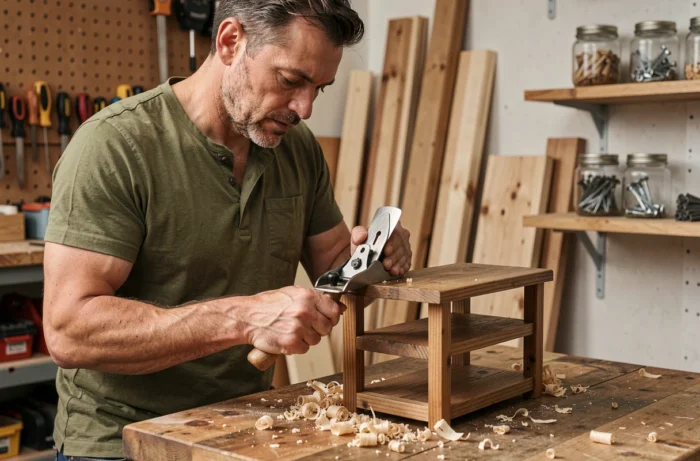
For furniture or shelves, recovered wood requires careful sanding and, depending on the type, treatment against moisture. Untreated wood in a damp room will warp within a few months.
Textiles and Soft Materials
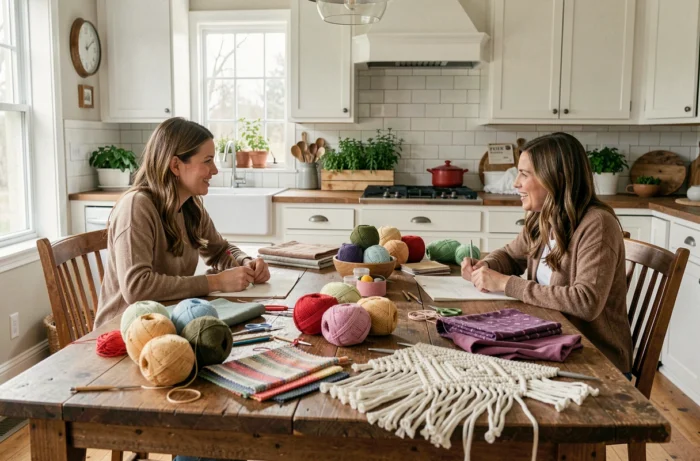
Fabric scraps salvaged from haberdasheries or end-of-stock allow for the creation of cushions, pouches, and placemats. The point of caution lies in the composition: a 100% polyester fabric does not react like linen or cotton when washed, sewn, and especially dyed.
- Cotton and linen accept natural dyes (onion skins, coffee grounds, turmeric) well and are easily worked with a domestic sewing machine.
- Polyester resists vegetable dyes and requires specific dispersion-based dyes, which are rarely available in regular haberdasheries.
- Cotton-polyester blends yield unpredictable results in dyeing: the color takes unevenly between fibers, resulting in an uncontrolled mottled appearance.
Paint and Artisan Finishes: Techniques Accessible Without Professional Equipment
Painting remains the fastest transformation lever for an object or piece of furniture. A few techniques yield results close to professional finishes without heavy investment.
Chalk paint adheres to most surfaces without a primer. It can be easily sanded to create a weathered effect and is protected with a clear wax. For furniture intended for daily use (table, chair), a coat of matte varnish is a better substitute for wax, which wears out in a few weeks on frequently used surfaces.
The stenciling technique on wood or textiles requires minimal equipment: a stencil cut from rigid cardboard, a flat sponge, and acrylic paint are sufficient. The classic trap is to overload the sponge with paint. It is better to dab lightly in several passes, which avoids smudging under the edges of the stencil.
Patinas and Material Effects on Decorative Objects
Ready-to-use concrete allows for covering pots, trays, or frames with a mineral finish. The preparation requires a precise mix (resin and powder) and a drying time of several hours between layers. The durability of these consumer kits varies greatly: some last several years, while others chip after a few months, depending on the thickness applied and exposure to moisture.
- For an outdoor flower pot, plan for at least three thin layers and a UV protection varnish.
- For an indoor decorative object, two layers are generally sufficient without additional treatment.
- Avoid applying ready-to-use concrete on smooth plastic: adhesion remains poor even with a bonding primer.
Handmade Creations and the Creative Economy: A Possible Extension Beyond Leisure
Home DIY sometimes leads to a selling activity, particularly through online platforms. Available data shows that more and more consumers prefer handmade products over industrial items, which opens a real outlet for amateur creators.
Some precautions are necessary before selling. The micro-entrepreneur status remains the simplest framework for declaring income from handmade sales. Obligations vary depending on the type of product: a decorative object does not meet the same standards as a toy or a textile in contact with the skin.
The creative economy, identified as one of the underlying trends for the coming years, relies on this ability to transform a manual skill into a marketable offer. The data does not allow for precise quantification of the DIY share in this market, but the dynamic is visible in the multiplication of collaborative workshops and fairs dedicated to DIY.
Transforming a hobby into a source of income requires mastering production consistency and finish quality. A sold object does not tolerate the same approximations as a personal project: expectations regarding the sturdiness of joints, cleanliness of seams, or uniformity of paint increase as soon as a price is displayed.