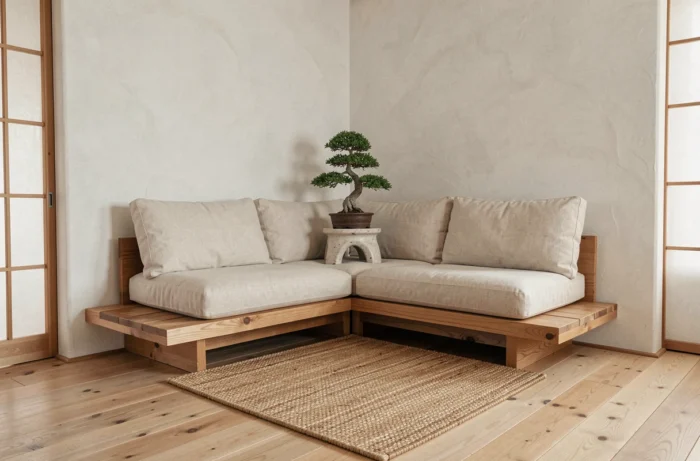
Searches related to zen decoration have steadily increased in recent years on French search engines. The phenomenon goes beyond mere aesthetics: it reflects a need for domestic calm, driven by lifestyles where the home serves as an office, a place of rest, and a social space.
The 2026 decor trends confirm this direction, with palettes, materials, and arrangements that prioritize a sense of tranquility over spectacular visual effects.
Raw materials and porcelain stoneware: the technical foundation of a zen interior
Most articles on zen homes focus on colors or furniture. However, the choice of covering materials shapes the atmosphere of a room long before any furniture is placed. Porcelain stoneware, often cited as the flagship material of interior decoration in 2026, illustrates this shift: it mimics stone, wood, or polished concrete while offering a durability that raw natural materials do not always achieve.
What makes this material relevant in a zen approach is its ability to visually unify a space. A continuous floor between the living room and the kitchen, without a threshold or color break, eliminates visual boundaries and expands the perception of space. Designers speak of a unified and continuous space, a principle adopted by several European manufacturers for their 2026 collections.
Natural materials (linen, hemp, boucle wool) complement this mineral foundation by adding tactile softness. Their role extends beyond decoration: they contribute to the acoustics of a room.
A thick wool rug or heavy linen curtains absorb a significant portion of sound reverberations, directly contributing to the feeling of calm. To follow the latest on Zen and Deco, these associations between mineral materials and natural textiles form a central axis of current selections.
Earthy palettes and natural light: two complementary decor levers
The dominant shades of 2026 move away from pure white and cold gray that have marked the last decade. Earthy palettes (clay, golden sand, terracotta) warm the atmosphere without overwhelming it. These colors function as a neutral yet lively backdrop, capable of varying with daylight.
It is precisely this connection with light that deserves attention. A clay hue on a south-facing wall will not produce the same effect as one facing north. In the former case, direct light reveals golden nuances. In the latter, the color leans towards brown and can weigh down the room if the rest of the decor does not compensate.
Adapting the palette to the room’s orientation
For a north-facing living room, light sands and rosy beiges maintain brightness. Deeper terracottas are better suited for rooms bathed in natural light, where they create a soft contrast with light wood furniture.
- North exposure: favor sand, linen, or greige tones, paired with light wood furniture to avoid a cave-like effect
- South or west exposure: deep clays and ochres work without darkening, especially if the floor remains light
- Through rooms: a single hue in two intensities (main wall vs. secondary walls) unifies the space without monotony
Artificial lighting extends or disrupts the work of natural light. Warm temperature bulbs (around 2700 K) preserve the coherence of earthy palettes in the evening. Too white lighting cancels the desired effect.
Biophilic design: beyond green plants on a shelf
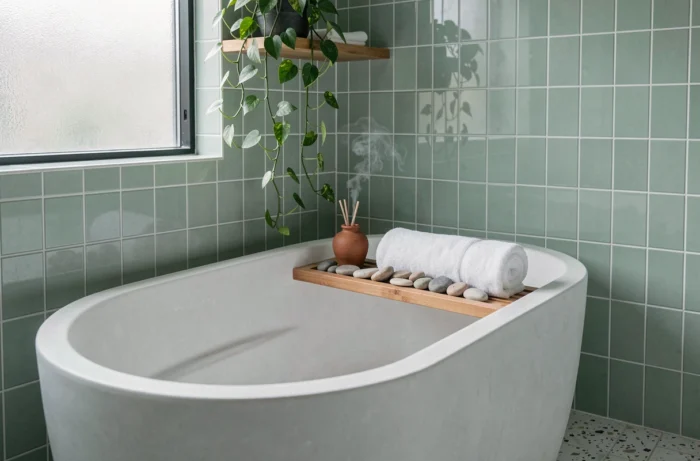
Incorporating plants into a zen interior is a recurring piece of advice, to the point of becoming a decor cliché. Biophilic design, as it unfolds in recent projects, goes beyond mere vegetation presence. It is about reproducing the rhythms and forms of nature in interior architecture.
Fluid and soft shapes replace systematic right angles. Arches in partitions, rounded furniture contours, oval wall niches: these elements create a visual flow that recalls organic lines. Modular furniture contributes to this logic by allowing the space to be reconfigured according to the times of day.
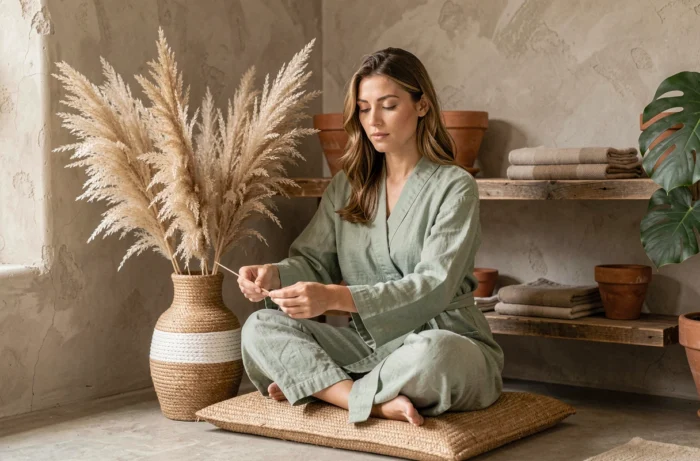
What biophilic design concretely changes in a living room
A living room designed according to these principles does not resemble an indoor jungle. It combines materials with visible grain (dark wood, reconstituted stone), vegetation chosen for its architectural foliage (ferns, monstera, fiddle leaf fig) and a layout that leaves empty zones. In a zen approach, emptiness is not a lack: it is a fully-fledged decorative element.
- Limit the number of decorative objects to a few artisanal pieces rather than multiplying knick-knacks
- Leave at least one wall clear in each room to allow the eye to rest
- Choose natural material planters (terracotta, rattan) rather than plastic, to maintain sensory coherence
Artisanal touch and zen style: a delicate balance
The trend towards craftsmanship in 2026 decoration raises a rarely discussed question: a poorly chosen artisanal object can disrupt the harmony of a zen space. A brightly colored pottery piece or an imposing sculpture draws attention and creates a point of visual tension, exactly the opposite of the desired effect.
Artisanal pieces that work in this context share specific characteristics: muted shades, textured but matte surfaces, modest dimensions. A stoneware bowl placed on a raw wood console brings warmth without overwhelming. In contrast, a collection of colorful ceramics lined up on a shelf transforms a calm space into a gallery.
Decluttering remains the foundational gesture of zen decoration. Before adding a new decorative object, the question to ask is what it replaces or the space it occupies. In a harmonious interior, each element justifies its place by its function or the feeling it provides, not by its market value or novelty.
The decor trends for a zen home in 2026 converge towards a simple principle: reduce visual stimuli to increase sensory comfort. The choice of materials, color palette, and management of emptiness matter more than the accumulation of designer furniture or trendy accessories. A successful zen interior is recognized by what has been removed as much as by what has been added.