A parent who forgets to turn off the stove. A step in the entrance that has become a daily obstacle. These small signals often go unnoticed, but they raise a concrete question: does the current housing still allow for safe living? Aging well at home is not just a wish. It is a project that requires precise adjustments, sometimes simple, sometimes costly, and coordination between the elderly person, their loved ones, and home professionals.
MaPrimeAdapt’ and funding for renovations: what really holds it back
Adapting a home for aging is expensive. Walk-in showers, stairlifts, widening doors: quotes can quickly add up. MaPrimeAdapt’ is the main scheme for financing these renovations, but its actual functioning is more chaotic than what the official brochures suggest.
The Anah office was temporarily blocked at the end of 2025 due to the failure to adopt the finance law. It only reopened on February 23, 2026. For several weeks, submitted files remained pending. For an elderly person waiting for the installation of a grab bar or the renovation of a bathroom, this delay can mean additional months in an unsuitable home.
The actual cost of renovations remains a major barrier even with assistance. The out-of-pocket expense, after subsidy, often exceeds what low-income households can manage. Before starting a project, it is better to have the out-of-pocket costs precisely estimated by a France Rénov’ advisor and to check that the credits are indeed available at the time of submission.
Home autonomy services: the reform families are unaware of
Have you heard of SAAD, SSIAD, SPASAD? These acronyms referred to the various home help and care services for elderly individuals. Since 2023, they have been gradually grouped under a single name: home autonomy services (SAD).
The goal is concrete. Before this reform, a person could have a cleaning aide managed by one organization and nursing care by another, without coordination between the two. The SAD merges these interventions so that a single point of contact organizes both daily assistance and care. On Seniorium, families can compare available structures near them and identify those that have already adopted this new functioning.
This reform changes the game for continuity of home care. When health deteriorates, the transition from light assistance to regular care occurs without service interruption, without a new file, and without additional waiting time. A single point of contact coordinates all interventions.
Senior housing modifications: priority areas to address
Not all rooms present the same level of risk. Rather than renovating everything at once, it is better to target the areas where accidents occur most frequently.
Bathroom and toilet
This is the most dangerous room in the home for an elderly person. Wet floors, stepping over the bathtub, lack of support points: falls are common here. Replacing a bathtub with a walk-in shower with a fold-down seat significantly reduces the risk. Fixed grab bars (not suction-cup) complete the installation.
Stairs and hallways
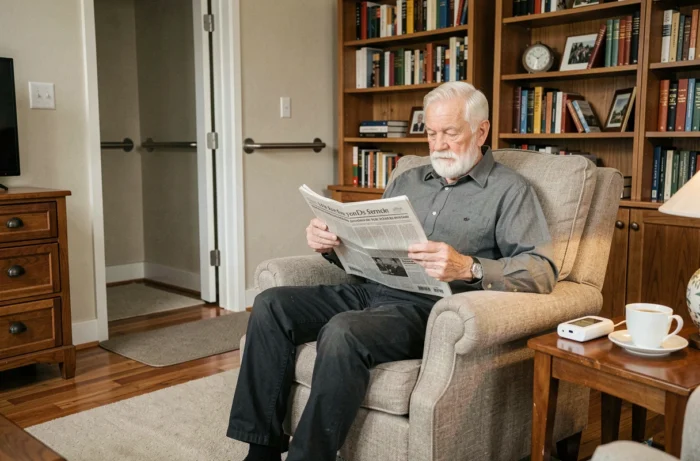
Automatic motion-detection lighting prevents moving around in the dark. Contrasting non-slip stair nosings help to identify each step. If the stairs become a daily obstacle, a stairlift or moving the bedroom to the ground floor is necessary.
Kitchen
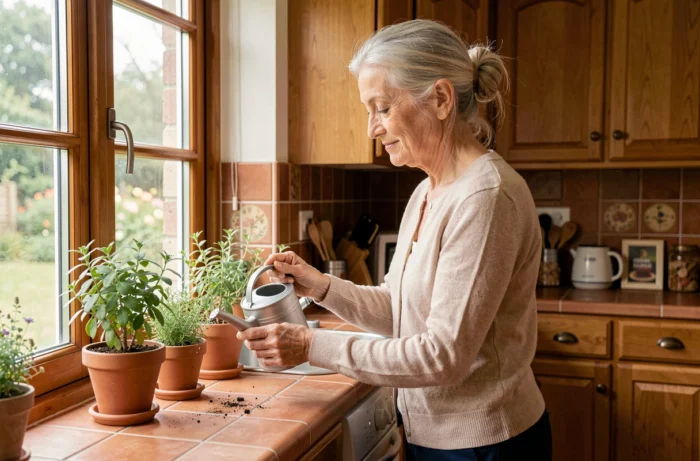
Induction cooktops with automatic shut-off are a safer alternative to gas. Storing frequently used utensils between waist and shoulder height avoids dangerous movements (bending down, climbing on a stool).
- Bathroom: walk-in shower, grab bars, non-slip mat secured to the floor
- Stairs: automatic lighting, contrasting stair nosings, handrail on both sides
- Kitchen: induction cooktops, accessible storage, non-slip flooring
- Entrance: removal of raised door thresholds, sufficient lighting upon entry
Decline of departmental home assistance: a signal to watch
A recent statistic deserves the attention of families. According to DREES, the use of departmental home assistance began to decline in 2025, even as the population ages. The APA at home is affected by this decline.
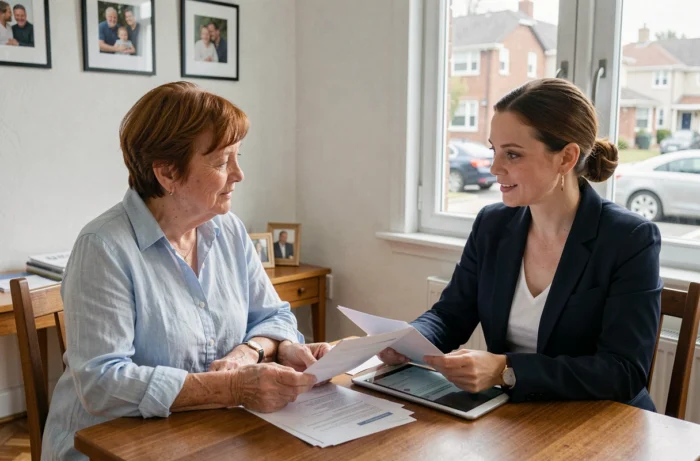
Several hypotheses are circulating: complexity of administrative procedures, long processing times, lack of awareness of rights. For family caregivers, this means that one should not wait for a visible decline in autonomy to file a claim. The personalized assistance plan proposed after evaluation by the department’s medical-social team can take several weeks before becoming operational.
A common trap: believing that the APA covers all necessary hours of assistance. The assistance plan has a ceiling that depends on the assessed level of dependency (classified in GIR). The monthly out-of-pocket expense varies according to resources. Requesting a detailed simulation from the Departmental Council before committing avoids unpleasant surprises.
- File for APA as soon as the first signs of loss of autonomy appear, without waiting for a fall or hospitalization
- Request a simulation of the monthly out-of-pocket expense from the Departmental Council
- Check if the department has transitioned to home autonomy services (SAD) to benefit from enhanced coordination
Aging well at home relies on three pillars that work together: housing adapted to the actual capabilities of the person, coordinated services that prevent breaks in care, and anticipated funding that takes administrative delays into account. Families who act early maintain control over their choices. Those who wait for an emergency face delays, costs, and default solutions.